Yoga, Stress, and Agni.....Peru anyone?
/"Create a life you don't need a vacation from."
October 2024
Recognizing the physiology that links stress, the immune system, the digestive system and mental health, and how to use this connection to your benefit.


"Our anxiety does not come from thinking about the future, but from wanting to control it.” – Kahlil Gibran
Scientists Can Explain the Physiology of the Link Between Stress and Health & Wellness
Anyone who has used yoga, nutrition and nature to resolve their stress and to balance their mind and emotions already has experienced this, but If you need something more concrete for your family and friends that fight the incense, essential oils, midnight fires, and sage smudging, the information is available, as in the following excerpts.

Chronic stress has been shown to alter intestinal permeability (leaky gut syndrome), which is associated with a low-grade inflammation that can be functionally linked to psychiatric disorders such as depression.
– Dr. Sanil Rege and James Graham PhD link
Stress makes us more likely to develop mood disorders. And stress makes the gut more permeable to bacteria. Reciprocally, depression causes dysbiosis —an imbalance of good to bad gut bacteria. In sum, depression is maybe caused by dysfunctional gut-brain-immune system interactions. Good gut bacteria or the absence of some bad ones can make us more resilient to depressive states after stressors or trauma. It is not surprising that chronic exposure to stress is associated with a higher incidence of depression, anxiety, and PTSD. But not everyone who faces stress develops a mood disorder, and not everyone who experiences a trauma develops PTSD. Resiliency, the ability to recover quickly from difficulties, is maybe a function of what bacteria lives or does not live in your gut. In one study… when microbiota from vulnerable rats was transferred to resilient rats, they displayed depressive behaviors... Also, stress and stress hormones such as cortisol can have a negative impact on our microbiome. And all of these factors interact in complex ways with the immune system… What all of the above findings strongly suggest is this: Take care of your gut bacteria for good quality of life, better mental health, and a sharper brain.
– Marwa Azab, Psychology Today link
So, we know the gut produces 80 to 90% of your body’s serotonin and has so many neurons that it qualifies as your “second brain.” Got it. Did you know that 70 to 80% of your IMMUNE SYSTEM is also in your gut? Think about that for a moment. The vast majority of your immune system IS IN YOUR GUT! Yet another data point to emphasize just how important it is for us to focus a proper amount of energy on optimizing our good ol’ gut, eh?!
– Brian Johnson, Optimize
Some of the ways that chronic stress can lead to imbalances in the digestive system include:
Decreased peristalsis (movement of food through the digestive tract) and digestion in the small intestine
Impaired absorption of food
Stomach acid issues, leading to indigestion and heartburn
The term, ‘Gut-Brain Axis’ was first coined in the 1960’s. It was originally used to describe the many signals that the brain sends to the gut. Everyone knows that the brain controls the body, but what controls the brain? One of the greatest advances in our understanding of psychiatric disease (and all human disease) is that this gut-brain axis is actually a two-way street.
– Kelly Brogan MD link
The vagus nerve is constantly sending updated sensory information about the state of the body’s organs “upstream” to your brain via afferent nerves. In fact, 80-90% of the nerve fibers in the vagus nerve are dedicated to communicating the state of your viscera up to your brain… Visceral feelings and gut instincts are literally emotional intuitions transferred up to your brain via the vagus nerve. In previous studies, signals from the vagus nerve traveling from the gut to the brain have been linked to modulating mood and distinctive types of fear and anxiety.
– Christopher Bergland, Psychology Today link

According to Ayurvedic philosophy, Agni governs all digestive and metabolic processes in the body. It is responsible not only for the digestion of food but also for the assimilation of nutrients, the digestion of everything you take in through your senses and the elimination of waste.
Ayurveda recognizes four main types of Agni based on how digestion works in the individual:
Sama Agni (Balanced Fire): This is the ideal state of Agni where digestion is efficient and balanced. It breaks down food properly, absorbs nutrients, and eliminates toxins, leading to good health.
Vishama Agni (Irregular Fire): Associated with a Vata imbalance, this type of Agni leads to irregular digestion. Sometimes the digestion is strong, while other times it's weak, resulting in bloating, gas, and constipation.
Tikshna Agni (Sharp or Intense Fire): Linked to a Pitta imbalance, Tikshna Agni causes overly strong digestion, leading to burning sensations, acidity, and sometimes diarrhea. The digestive fire is too intense, burning through food too quickly.
Manda Agni (Slow Fire): This type of Agni, associated with a Kapha imbalance, is sluggish and weak. It leads to slow digestion, lethargy, heaviness, and weight gain.
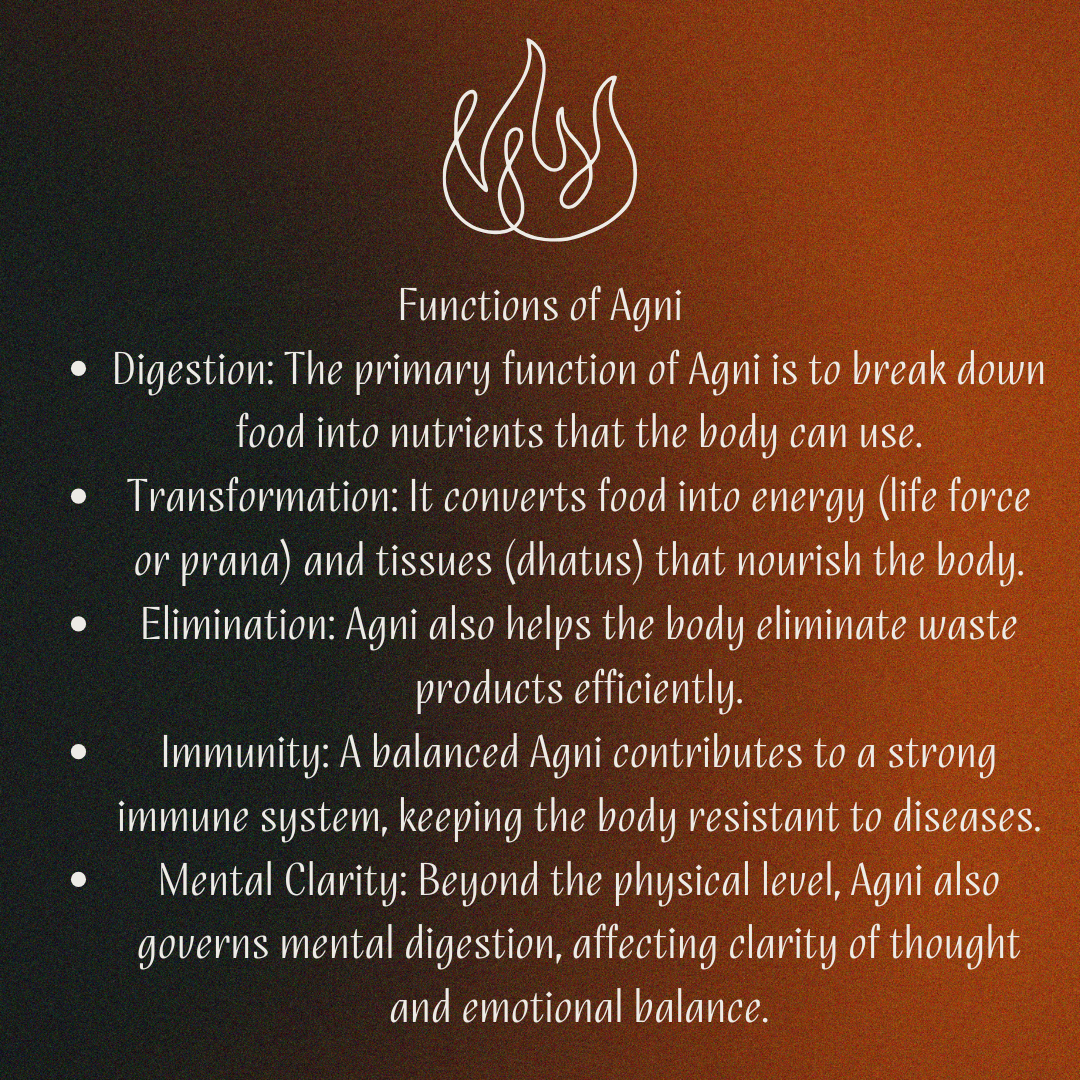
Signs of a Balanced Agni
Regular appetite and proper digestion
Feeling light and energetic after meals
Clear and healthy skin
Balanced weight and metabolism
Clear and focused mind
Regular bowel movements
Weak or Imbalanced Agni
When Agni is weak or imbalanced, it leads to the accumulation of Ama (toxins), which is the root cause of many diseases in Ayurveda. Signs of weak Agni include:
Indigestion, bloating, or gas
Loss of appetite or extreme hunger
Constipation or diarrhea
Fatigue and lethargy
Foggy mind or emotional disturbances
To strengthen Agni, it's essential to adopt mindful eating habits, such as eating at regular intervals and avoiding overeating or skipping meals. Incorporating warming spices like ginger, cumin, black pepper, and fennel can naturally stimulate digestion. Favor warm, cooked foods over raw or cold ones, as they are easier for the digestive fire to process. Drinking warm water or herbal teas throughout the day helps maintain digestive strength, while avoiding incompatible food combinations prevents the formation of toxins, like raw fruit combined with any other food (in Ayurveda fruit plays alone if it isn't cooked). Additionally, regular exercise, stress management techniques like yoga or meditation, and maintaining a consistent daily routine all contribute to a stronger and more balanced Agni.
Research
Meta-analysis of 300 articles: Chronic release of stress hormones can weaken the immune system, and increase the risk of numerous health issues such as heart disease, depression, and obesity (2004)
Analysis of more than 300 articles describing a relationship between psychological stress and the immune system
“The more a stressor…[became] chronic, the more components of the immune system were affected in a potentially detrimental way.”
Research: link
Dr. Joseph Mercola: link
Stress canceled out the positive effects of a healthy diet (2016)
UK-based study tracked blood levels to measure inflammation in two groups of women: 1) One group ate an anti-inflammatory diet. 2) Another ate a pro-inflammatory diet
For participants who reported low stress, the results were as expected: Subjects who at the pro-inflammatory diet showed increased inflammation and hose who ate the anti-inflammatory diet showed decreased inflammation.
But for those women who reported high levels of stress, it didn’t matter which diet they ate: both dietary groups had elevated levels of inflammation!
“If stress has the ability to cancel out the positive effects of a healthy diet, then what other factors might also be at play? It’s time for us to think more holistically about our lifestyle.”
Published in Nature magazine
Source: link
Chronic stress weakened (“accelerated aging of”) the immune system (2022)
In this study, researchers set out to discover why immunosenescence (accelerated aging of the immune system) starts earlier in some people than in others.
“Circulating white blood cells become ‘old and tired’ and not enough new, ‘fresh’ white blood cells are produced to replace them. They found that people with higher stress scores (on a questionnaire) had more signs of immunosenescence than people with lower stress scores… “Stress is a risk factor for poor health and accelerated aging. Immune aging plays a role in immune health and tissue-specific aging, and may contribute to elevated risk for poor health among those who experience high psychosocial stress.” (Chris Kresser, Functional Medicine clinician)
Due to this impact on the immune system, chronic stress thus can increase the likelihood of cancer, cardiovascular disease and infections, for example.
Published in PNAS, The Proceedings of the National Academy of Sciences, a peer-reviewed journal of the National Academy of Sciences (NAS)
Source: link

Resolving Stress & Developing Resilience
The connection between physiology and stress shows why relieving stress and building resilience lead to better physical and mental health. By consistently applying the principles of yoga, we can regularly alleviate stress and enhance overall well-being.
The fight or flight response is associated with increased levels of adrenaline and cortisol, making it crucial to break out of the stress cycle. The stress cycle is also associated with unhealthy coping mechanisms and habits such as overeating, alcohol and substance use. Exercise, a renewed focus on positive thinking, seeking creative outlets, social activities, proper nasal breathing and self-care are effective ways to escape the stress cycle.
– Dr. Joseph Mercola link
Stress resilience is your natural inborn ability to bounce back from the anxiety response that is an inevitable part of life. Stress resilience is, in fact, as natural as the stress response.
– Emma Seppala PhD, Psychology Today link
The whys......
Yoga is highly successful at invoking the relaxation response, thereby balancing the nervous system that may be stuck in chronic sympathetic nervous system activation.
Do to the fact that sympathetic nervous system activation causes muscular tension and contracts the psoas, releasing muscular tension, particularly in the psoas, can support the release of stress.
Yoga may also be a part of promoting positive stress (eustress).
More options for resolving a stress cycle include other mindbody or somatic experiencing modalities, energy healing and cord cutting, EFT, reprogramming the subconscious and behavioral changes such as setting new boundaries.
In the case of trauma, specialized approaches have proven highly successful.
As needed, consider a more individualized approach. For example, an experienced provider here explains that some people may have difficulty discerning subtle sensations and as they shift between ANS states, they may experience discomfort that can be difficult to interpret. Measuring heart rate variability (HRV) can provide vital information in such a case.


Going on a retreat offers a powerful way to release stress by providing a dedicated space for rest, reflection, and reconnection. Away from the demands of daily life, retreats immerse participants in peaceful environments that promote relaxation and mental clarity. Guided practices like meditation, yoga, and mindfulness help calm the mind and release tension stored in the body, while natural surroundings encourage deeper breathing and presence. The structured yet flexible retreat schedule allows for self-care without distractions, fostering an inner sense of calm and balance. This intentional time away nurtures physical, emotional, and mental renewal, making it an ideal solution for reducing stress and restoring well-being.
Talked you into it yet? Maybe it's time to embark on a sacred journey to Peru, where ancient landscapes and timeless wisdom await. Explore the mystical valleys of the Andes, connect with the energy of sacred sites, and experience profound transformation. This is more than a retreat—it’s a pilgrimage to rediscover your inner self. Your journey begins here:
Let's go to Peru! Be.Boundless Yoga Retreat
Link to Register to the Open House for Peru! Learn more on Wed., Oct 23 @ 6pm :)