
Is your central nervous system your friend?
/"If your compassion does not include yourself, it is incomplete."
-Jack Kornfield

"The great thing then, in all education, is to make our nervous system our ally instead of our enemy."
- William James
I don't know about you but I'm definitely finding moments were my nervous system doesn't seem like my best friend these days. My practice, whether it be the stillness of meditation, the movement of asana, or the new challenge of running; each have a place in bringing me back to the present moment. In times like these compassion is soooo important. Not just compassion for others as we are trying to maintain social distancing but compassion for ourselves. The roller coaster of emotion that day to day life takes us through is tough. There are highs like cuddling on the couch with children, talking to an old friend over the phone, or just sitting down to a home cooked meal, no rush or time constraints- to the emotional lows of wondering about the future, not being able to hug your best friend, or just the utter lack of control. There are no right or wrong feelings, give yourself permission to feel it all, love yourself. Practice grace, the benefit of a pause, and listen to the beat of your heart.
Sometimes the greatest peace can be found in the space between two breaths, the gratitude of quiet to acknowledge it. The space to appreciate that small in between spot that can be found literally anywhere. As long as you are breathing then there is time. Following you'll find some deeper information on the central nervous system. Let's gain an appreciation together for the magical system that is YOUR body and the way you can ally yourself with it, instead of fighting against it.
You can't social distance from yourself, but you can lean in, make friends with, and be grateful for the tools at your disposal. So take a deep breath my friend. Release it slowly.
You are stronger then you know. You have everything you need. You are loved.
The Nervous System
The nervous system is essentially the body's electrical wiring.
- Livescience
Overview
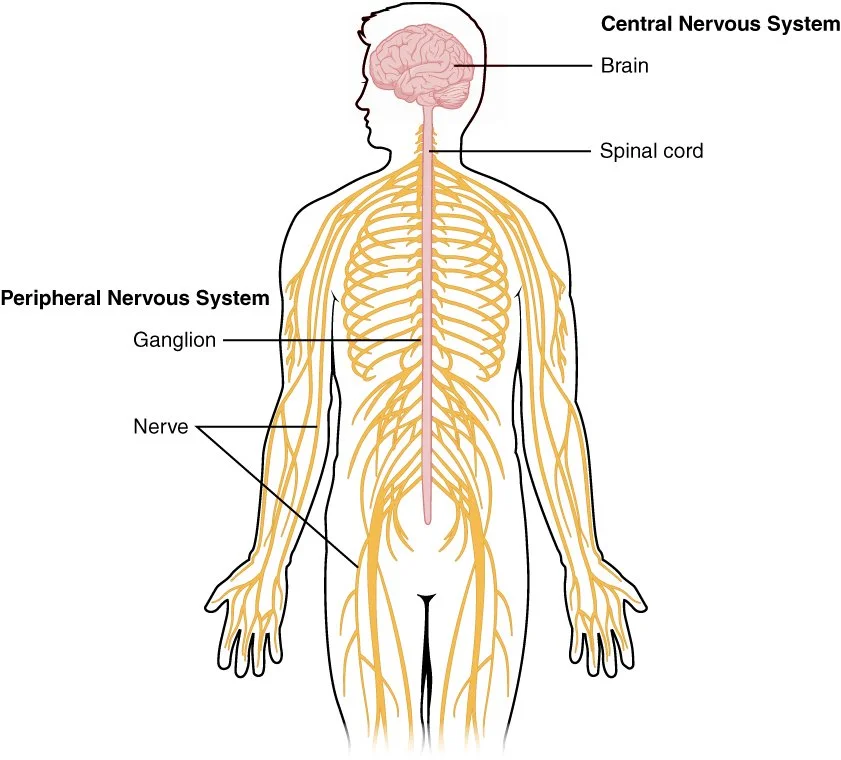
The nervous system consists of the brain, spinal cord, neurons, nerves, meninges, cerebrospinal fluid and sensory receptors.
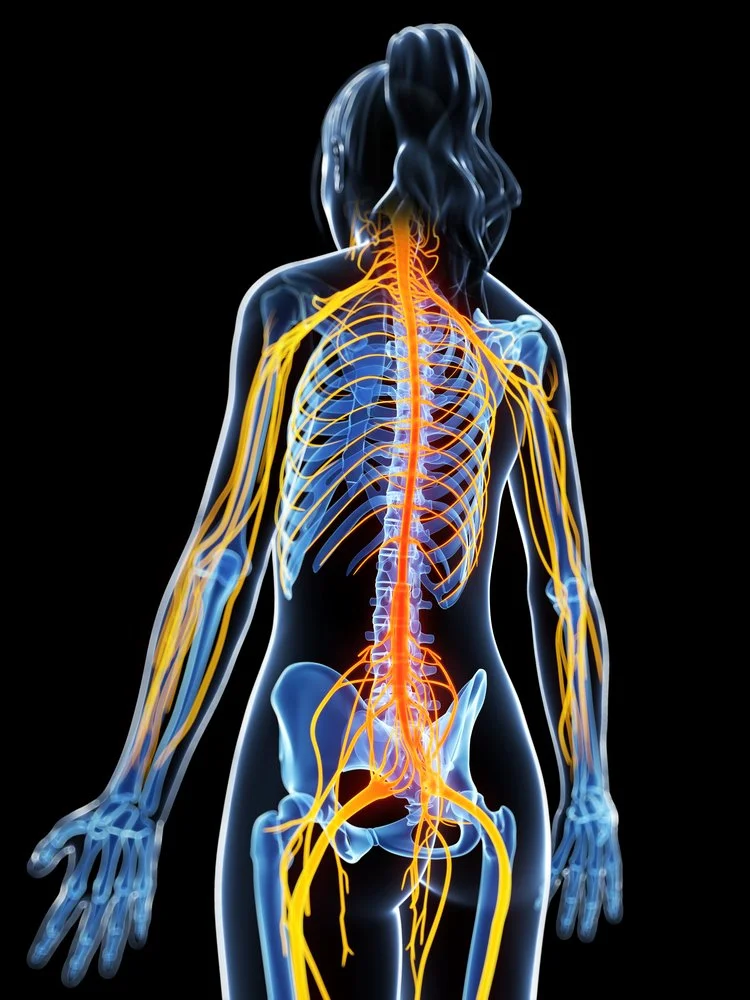
The nervous system includes a collection of nerves and neurons that transmit signals between different parts of the body.
The “basic working unit” of the nervous system is a cell called a neuron.
Neurons communicate via electrical signals which are converted into chemical messengers called neurotransmitters.
The nervous system is divided into the central nervous system and the peripheral nervous system.
The central nervous system (CNS) is comprised of the brain and spinal cord.
The peripheral nervous system (PNS) contains all the nerves that lie outside of the spinal cord and brain.
The PNS is divided into the somatic (voluntary) and autonomic (typically involuntary) nervous systems.
What does it do?
Regulates certain body processes such as blood pressure and the breathing rate.
Connects the brain and spinal cord with muscles and sensory receptors.
More Detail
The functions of the nervous system can be categorized as 1) sensory, 2) integration and 3) motor. (InnerBody)
Sensory function: collecting information and passing it on to the central nervous system
Integration: evaluation of the signals by the brain and spinal cord
Motor function: carrying of signals from the CNS that can result in, for instance, moving a part of the body.
By communicating through your nerves, your nervous system constantly monitors the internal activities of your body systems, attempting to keep them in a healthy balance called “homeostasis.” It also monitors your environment to assess if it is safe or dangerous, and sends messages to your body, either to relax and enjoy, or act quickly to get to safety.
– Yoga for Healthy Aging
What is your central nervous communicating to your body?
Have you been telling yourself relax and enjoy?
Or act quickly and get to safety?
Are you giving your body signals unconsciously that are sending messages of fear?
Yoga is awareness, so lean into this present moment and be honest with yourself.
There is no right or wrong, just a deeper understanding.
The ANS: Sympathetic & Parasympathetic Systems
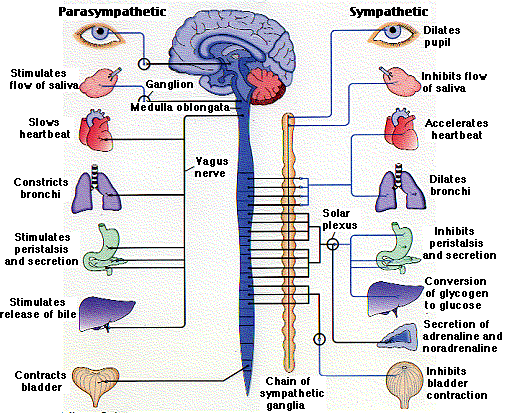
The autonomic nervous system (ANS) governs the typically automatic functions including breathing, heart rate and the endocrine (hormone) system.
The ANS is an area of particular focus for understanding how yoga practices reduce negative effects of chronic stress and improve health and wellness.
The ANS is divided into the sympathetic and parasympathetic nervous systems.
The sympathetic nervous system triggers the stress response. When stress is perceived to be excessive or threatening, a physiological reaction called the Fight or Flight Response occurs.
The parasympathetic nervous system controls the Relaxation Response and the Rest and Digest state (which indicates full parasympathetic activation when the body’s vital signs are in their calm state, and the immune, repair, and digestive systems are operating).
Triggering the Relaxation Response with the Breath
You may be unaware when you're breathing shallowly or inefficiently, contributing to anxiety, stress or tiredness.
Focusing on the breath is a fundamental tool for settling the mind and feeling the body.
Conscious breathing is known for its positive effects on stress reduction and pain management.
Mindful breathing is a safe way to strengthen and expand your respiratory capacity.
The most important instruction is to consciously relax
A fuller breath can often be initiated through focusing on the exhalation, because inhalation comes naturally from a complete exhalation. Your body wants to live, it will inhale. So the magic happens in the exhale. In addition, the exhalation is associated with calming, grounding and soothing anxiety.
A breathing practice called Viloma Pranayama (Against the Grain Breathing) is a practice of dividing the inhalation and/or exhalation into parts.
Viloma is derived from two Sanskrit words Vi and Loma.
Vi :negation
Loma: hair
Viloma: anti-hair/against the natural order of things- hence, against the grain.
Below is the an example of how to do this breath pausing in the inhale and the exhale. But you can choose to only take the pauses (which are just suspensions in breath) in the inhale or in just the exhale. Play with all three and see how they feel in your body. And remember that it is totally fine to take a couple of regular breaths in between the Viloma breaths if needed.
Sitting or lying - spine is in a straight line.
Observe your breath. Where ever it is at without judgement.
Inhale and fill your lungs completely. Exhale everything.
Inhale for 2-3 seconds, pause, retain your breath for 2-3 seconds. Continue to do this until the lungs are completely full. Don’t strain yourself. I prefer to work in thirds.
Exhale for 2-3 seconds, then pause, retain or hold your breath for 2-3 seconds, pause once again. Repeating until your lungs are empty- again, I prefer to work in 3 parts.
This completes one cycle. Repeat for 5-7 minutes.
Why would you focus on just breaking up the exhale?
Exhaling in parts may make you feel more present and "in your body." Pausing and dividing the breath can “trick” us into taking a longer breath.
Additionally it relaxes the nervous system aiding in sleep and reducing anxiety by releasing tension and cooling the body. It also increases lung capacity and breath control.
As I said before, play with all three. Personally when I'm trying to connect more with the present I break up both the inhale and the exhale. When I need more energy I break up only the inhale. When I'm trying to sleep I break up the exhale.
You try it and let me know how it works for you!
Viloma Pranayama (on the Exhale)- I'll walk you through it. :)
Yoga Classes/Privates
Classes are on ZOOM right now-
They should be on this room, but if it doesn't work or needs an password- shoot me an email or DM me through social media. These things are rapidly changing. xoxo
https://zoom.us/j/9042439457
Looking for Classes ON DEMAND?
Subscribe to my YouTube Channel-
https://www.youtube.com/channel/UCQhmmK1TSRMPCB4QY0B7YFg?view_as=subscriber
Contemplating privates? Small groups online- let's talk!
Shoot me an email from my website-
https://www.aprilfort.com/privates
Join Me in Class for More! Schedule is here!